
List of Drug Charges and Sentences in Pennsylvania
Pennsylvania has strict charges and sentences for drug possession, with sentences depending on an array of factors.
Navigating Pennsylvania’s state laws and federal legislation regarding drug offenses can be challenging without the assistance of an experienced attorney. Before enlisting professional support, it can be helpful to understand more about various drug charges and sentences in Pennsylvania.
What Determines a Drug Sentence in Pennsylvania?
Different drug offenses carry different weights, and drug sentences are determined based on a combination of state and federal laws, sentencing guidelines and the unique circumstances of each case.
A sentence is rarely a single number, but rather a range that is calculated using the PA Sentencing Guidelines.
The primary factors used to determine a drug sentence in PA are:
- Prior record score: The defendant’s prior record score (PRS) reflects the defendant’s previous criminal history. If a defendant has prior convictions related to drug offenses, their sentence is likely to be more severe than that of someone with a clean slate.
- Offense gravity score: Every case is assigned an offense gravity score (OGS), which reflects the severity of the defendant’s offense and is used to determine the length of their sentence.
- Type and classification: One of the most influential factors used to determine a sentence is the type and classification of the drug involved. Pennsylvania categorizes drugs into five schedules, where Schedule I includes the drugs with the highest potential for abuse and no acceptable medical uses in PA, and Schedule V includes those with the lowest potential for abuse.
- Quantity: The quantity of a drug involved in any offense directly impacts the severity of the defendant’s sentence. The quantity of drugs determines whether the defendant is charged with simple possession or possession with intent to deliver (PWID).
- The judge’s discretion: Each judge uses their discretion to interpret the various guidelines and reach a decision that they believe is fair and appropriate.
- Specific circumstances: Some considerations include the location of the crime, the involvement of minors and the use of weapons.
It’s important to remember that although these factors are extremely influential, they are only guidelines and the sentence for each defendant is determined on a case-by-case basis. A skilled attorney experienced in PA drug laws can help you understand the factors that affect your case and develop a strategy.
Understanding Pennsylvania Drug Schedules
Pennsylvania classifies drugs into five schedules, based on their potential for abuse, considering their harmfulness and addictiveness.
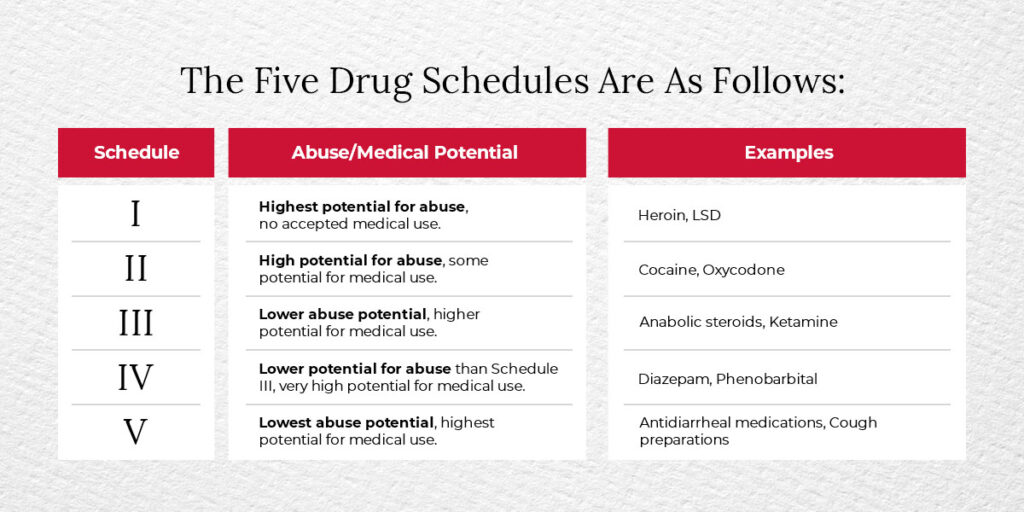
The five controlled substance schedules are as follows:
- Schedule I: Drugs with the highest potential for abuse and no accepted medical use. Examples of Schedule I drugs include heroin and LSD.
- Schedule II: Drugs with a high potential for abuse with some potential for medical use. Examples include cocaine and oxycodone.
- Schedule III: These drugs have a lower abuse potential and a higher potential for medical use. Examples of such drugs include anabolic steroids and ketamine.
- Schedule IV: Drugs with a lower potential for abuse than those in Schedule III and a very high potential for medical use. Examples include diazepam and phenobarbital.
- Schedule V: These drugs have the lowest abuse potential and the highest potential for medical use. Examples include antidiarrheal medications and cough preparations with under 200 milligrams of codeine per 100 milliliters.
Simple Possession in Pennsylvania
In Pennsylvania, simple possession is defined as the knowing or intentional possession of a controlled substance without a valid prescription.
This type of offense applies only to personal use amounts, which are not enough to suggest the drugs are intended for sharing with or selling to others.
Simple possession is generally the easiest charge for a prosecutor to prove in a drug-related case, as they are only required to demonstrate the possession or use of the substance and the lack of a prescription or license.
Penalties for simple possession of drugs, excluding marijuana:
- For a first-time offender: Up to one year in jail and a $5,000 fine.
- For subsequent offenses: Up to three years in jail and a $25,000 fine.
Penalties for simple possession of marijuana:
- For a first-time offender: For possession of up to 30 grams, defendants face up to 30 days in jail and/or a fine of up to $500. For possession of over 30 grams, it is considered a misdemeanor punishable by up to one year in jail and/or a $5,000 fine.
- For subsequent offenses: Punishment can include up to three years in prison and a fine of $25,000.
While these penalties are statutory maximums in Pennsylvania, if you are a first-time offender, your attorney may help you qualify for a diversion program, such as an Accelerated Rehabilitative Disposition (ARD) Program.
Possession With Intent to Deliver
Possession with intent to deliver (PWID) is a more serious offense, which implies the defendant had planned to sell, distribute or manufacture the drug.
PWID can be harder for a prosecutor to prove, but the factors most commonly used to prove intent include:
- Quantity: The police or prosecutor must prove that the quantity of the drug could not be considered viable only for personal use.
- Presence of equipment: Equipment that supports PWID includes the possession of drug paraphernalia, scales, burner phones and drug packaging materials.
- Cash: Large amounts of cash can be used to indicate the sale of drugs.
- Employment status: If the defendant does not have an official job at the time of their arrest, the prosecutor may assert that the sale of drugs is a source of income.
- Direct evidence of sale: Whether from witnesses, surveillance or uncovered ledgers, prosecutors can use evidence to prove PWID.
Possession with intent to deliver is almost always considered a felony, rather than a misdemeanor.
In Pennsylvania, the penalties for possession with intent to deliver are divided into the following tiers:
- Schedule I or II narcotics: Up to 15 years in prison and a fine of up to $250,000.
- Schedule I, II or III non-narcotics: Up to five years in prison and a fine of up to $15,000.
- Schedule IV substances: Up to three years in prison and a fine of up to $10,000.
When it comes to navigating a PWID charge, it is important to note that although Title 18 Section 7508 lists “mandatory minimums,” Pennsylvania courts have ruled many of these minimums unconstitutional. Having an experienced attorney is, therefore, crucial to ensuring your case is handled with the utmost discretion and care.
Defending Against Drug Charges in York County
Depending on the unique circumstances of each case, there are several defenses your attorney may be able to use to minimize your sentence.
Common defenses include:
- Illegal search and seizure
- Constructive possession
- Lack of intent
- Lab testing
If you get charged with either simple possession or possession with intent to deliver, having an attorney with experience with local judges, prosecutors and protocols is essential to ensuring you get the best defense for your case.
Prevent a Charge From Becoming a Conviction With MPL Law
At MPL Law, our dedicated attorneys have the expertise in possession and drug trafficking laws in Pennsylvania to help you navigate the complexities of a drug charge.
For over 40 years, we have been delivering high-quality legal solutions to residents of York, PA and the surrounding areas. We listen to our clients to understand their needs and develop practical approaches to achieve the best possible results. We value honesty and transparency, which has enabled us to build long-standing relationships with our clients. Our innovative and forward-thinking approach is the secret to our success.
If you or a loved one has been charged with drug possession, submit a contact form for a consultation and case evaluation.