

Client Alert: Commonwealth Court Limits Municipal Utility Fees
Written by Andrew Miller and Tom Wymard
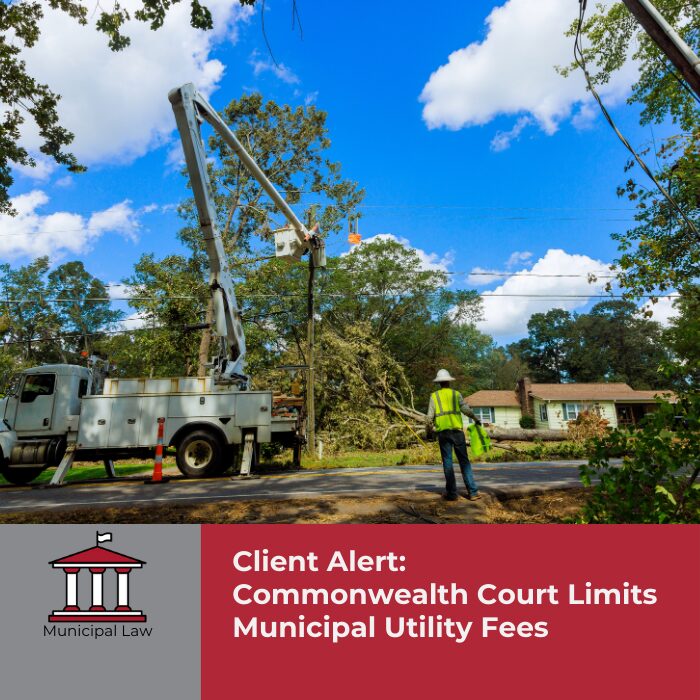
On January 2, 2026, the Commonwealth Court of Pennsylvania issued a significant decision in Columbia Gas of Pennsylvania, Inc. v. Menallen Township, 2026 WL 15658 (Pa. Commwlth. Jan. 2, 2026), that clarifies and limits the authority of municipalities to regulate and charge fees related to public utility work within public rights-of-way. This case also signals that the Commonwealth Court may be set to limit the amount of oversight municipalities may assert on utility projects that involve street cuts of municipal-owned streets.
Key Takeaways for Municipalities:
The Court reaffirmed that regulation of public utilities is field-preempted by the Pennsylvania Public Utility Code and lies exclusively with the Pennsylvania Public Utility Commission (PUC). While municipalities retain authority to manage access to their roads and rights-of-way, that authority is narrow and administrative in nature.
Permissible Fees Remain Limited
The Court confirmed that municipalities may continue to charge reasonable, flat permit application fees tied to administrative processing and basic right-of-way access. Such fees are consistent with prior case law and statutory authority.
However, the Court struck down Menallen Township’s variable inspection fees—which were calculated on a per-hour and per-square-foot basis—as unlawful. These fees were found to go beyond simple permit administration and instead functioned as utility regulation by funding extensive construction oversight and long-term roadway monitoring.
Inspection vs. Regulation
A critical aspect of the decision is the Court’s focus on purpose rather than amount. Even if a fee is labeled an “inspection fee,” it will be invalid if it is designed to:
• Oversee construction methods already regulated by the PUC
• Monitor utility installation quality beyond permit compliance
• Anticipate or offset future roadway maintenance costs
Such functions, the Court held, are materially similar to utility regulation and therefore preempted.
Unenforced Ordinance Provisions
The Court declined to rule on ordinance provisions governing the location, depth, and relocation of utility facilities because the township had never enforced them. While those provisions were not invalidated, the decision signals that enforcement of similar requirements could trigger future legal challenges.
Practical Implications
Municipalities—including townships, boroughs, and cities—should review existing street opening and utility permitting ordinances and fee schedules to ensure:
• Fees are flat, reasonable, and tied to administrative costs
• Inspection requirements are limited to confirming compliance with permit terms
• Ordinances do not attempt to regulate utility construction standards or practices
Failure to align local ordinances with this decision may result in injunctions, mandatory fee refunds, and increased litigation exposure.
If you have questions about this Client Alert or would like to discuss how these developments may affect your municipality, please contact one of our municipal law attorneys:
Andrew Miller | Tom Wymard
MPL Law Firm – York Office
Phone: (717) 845-1524
Matt Turowski | Rob Davidson
MPL Law Firm – Bloomsburg Office
Phone: (570) 784-6770
About the Author
