

Don’t Always Believe Your Eyes
Written by Charles Rausch
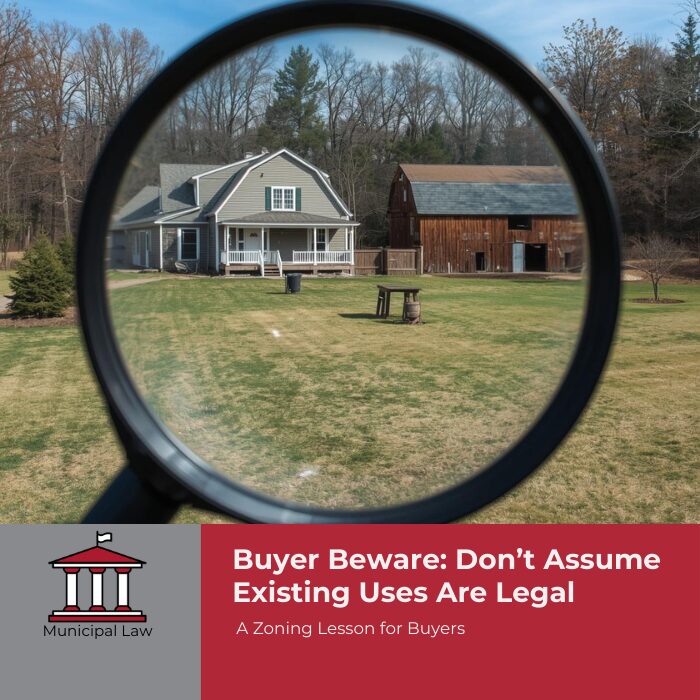
Sometimes, things are not what they appear to be. In Rylka v. Zoning Hearing Board of Hamilton Township and Hamilton Township (Commonwealth Court, filed January 26, 2026), the Rylkas learned this the hard way.
In 2018, the Rylkas purchased a 13-acre parcel that had three buildings: a single-family residence; a detached garage with two apartment units; and, a barn with two, unfinished apartment units. The township had been told by the prior owners that the two garage units were used by their teenage children. When the children no longer used the units, they were rented out to third parties. The prior owners constructed the barn in 2012, and although they installed plumbing and electrical service for two units, they never finished the construction and never rented out the two units before selling the property to the Rylkas.
Prior to purchasing he property, the Rylkas did not conduct any due diligence regarding zoning requirements, or whether the Sellers had obtained all necessary permits for the multi-family uses on the property. The Rylkas did hire an attorney, but the attorney apparently was retained only to prepare and review documents, and not to investigate zoning compliance.
After purchasing the property, the Rylkas continued to rent out the two garage units, completed construction of the barn, and began renting out those two units. The Rylkas performed the work and rentals without any township permits or approvals. At some point, the Rylkas had to re-route the sewer lines from the garage and barn, but did the work without any permits. The township’s former zoning officer had visited the property, but never inspected the units. There were multiple mailboxes that were visible from the road.
In 2018, a neighbor complained to the township that people were living in detached buildings on the property. The current zoning officer observed from the road that the buildings had multiple electrical meters, a second-story deck with sliding doors, double-hung windows and a parking area, all of which indicated that people were living in the units.
In 2022, the zoning officer sent an enforcement notice to the Rylkas citing violations for having multi-family uses on the property that were not allowed in the agricultural zoning district, and not obtaining the proper permits or verifying sewer and water capacity.
The Rylkas appealed the enforcement notice to the zoning board. The Rylkas did not contest that the garage and barn contained rental units, or that multi-family uses are prohibited in the agricultural district. Rather, the Rylkas argued that they are entitled to continue to use the rental units on the theories of vested rights, variance by estoppel, or by equitable estoppel. The zoning hearing board rejected the Rylkas’ arguments, and the lower court affirmed the zoning hearing board’s decision.
On appeal to the Commonwealth Court, the focus was whether or not the Rylkas were entitled to a vested right, variance by estoppel or equitable estoppel. The Commonwealth Court said no to all three arguments.
To be entitled to a vested right to continue to use property in violation of zoning regulations, the municipality must have issued a permit in error. In addition, the landowner must have acted in good faith in the issuance of the permit and incurred significant non-recoverable costs. Although permits were issued for the construction of the structures, the township never issued use and occupancy permits to allow the multi-family uses. As for the township’s awareness of renting out the units, the testimony of the prior owners indicated that the garage units were to be used by the owners’ children, and not rented out to third parties. Since no permits were issued in error, the vested rights argument failed.
A variance by estoppel is an extraordinary remedy and requires that the following facts are present: (1) a long period of time of municipal inaction to enforce the law, and the municipality knew or should have known of the violation and actively acquiesced in the illegal use; (2) the landowner acted in good faith and acted innocently upon the validity of the use; (3) landowner has made substantial expenditures in reliance that the use was permitted; and (4) whether the denial of the variance would cause undue hardship on the landowner. The Commonwealth Court found that nothing in the record showed that the township knew that the structures were being rented out to third parties and that the township acquiesced in the illegal use. Also, the Rylkas could not blindly rely on representations on the real estate listing or the Seller’s Disclosure form to satisfy their obligation to independently investigate zoning compliance. Finally, there was insufficient evidence that the attorney hired by the Rylkas was specifically retained to investigate zoning compliance.
The final argument of equitable estoppel prohibits a municipality from enforcing its regulations when the municipality: (1) intentionally or negligently represents the use was permitted; (2) knows that the landowner will rely on the misrepresentation; and (3) the landowner was induced to rely on the misrepresentation to his detriment. The Commonwealth Court found that the record did not contain any evidence that the township intentionally or negligently made a misrepresentation to the prior owners or to the Rylkas that a multi-family use was allowed on the property.
The major lesson to be learned from this case is that a buyer cannot assume that existing uses on the property are legitimate just because they are there. A buyer has an obligation to independently investigate what uses are allowed on the property. This was particularly important in this case, because the Rylkas were depending on the rental income to support the mortgage on the property. Also, buyers need to make sure that if they use an attorney, there is a clear understanding of what is the scope of representation of the attorney. In this case, what the Rylkas thought the attorney was going to do was not the same as what the attorney thought he was hired to do.
About the Author
