

Are Data Centers “Manufacturers” Under Pennsylvania Tax Law?
Written by Katelin Carter
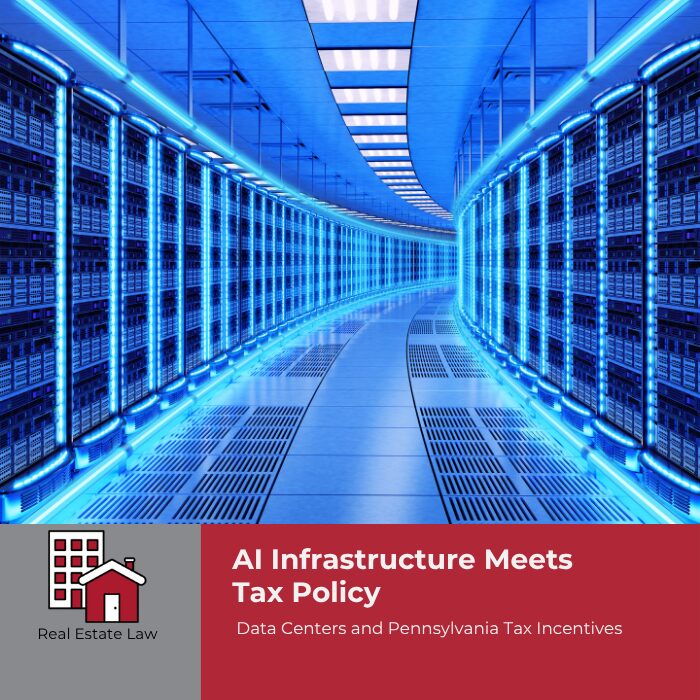
As demand for cloud computing and generative artificial intelligence accelerates, large-scale data centers have become critical infrastructure for the modern economy. These facilities house extensive networks of servers and cooling systems that store and process massive quantities of digital information. Their rapid expansion, however, raises an increasingly important tax question: do the machines inside a data center qualify for Pennsylvania’s manufacturing sales-tax exemption?
At first glance, the answer might seem straightforward. Pennsylvania’s manufacturing exemption generally applies to machinery used directly in the production of tangible goods. Data centers, by contrast, process digital information rather than transform raw materials into physical products. Under traditional interpretations of the exemption, therefore, data-center equipment likely falls outside the manufacturing category.
But the analysis does not end there. Recognizing the economic significance of large-scale computing infrastructure, Pennsylvania has created a separate statutory tax incentive specifically for certified data centers. The resulting framework illustrates a broader tension in state tax law. Regulatory doctrines built around twentieth-century industrial production are now being applied to twenty-first-century digital infrastructure.
The Traditional Manufacturing Exemption
Pennsylvania’s sales and use tax regulations exempt certain purchases by businesses engaged in manufacturing or processing. The exemption applies to tangible personal property and certain taxable services that are predominantly used directly in manufacturing operations. In practice, the exemption typically covers machinery, equipment, and related components that play an active role in producing tangible goods. Courts and tax authorities evaluating whether property is “used directly” in manufacturing often consider factors such as:
- how closely the property is connected to the production process,
- whether it is used during the production stage rather than before or after it, and
- whether it actively contributes to the transformation of materials into a finished product.
The regulations also impose a predominant-use requirement. Property must be used more than fifty percent of the time in qualifying manufacturing activities.
Data centers do not fit neatly within this traditional framework. Rather than transforming raw materials into physical products, data centers provide computing power, data storage, and information-processing services. Pennsylvania’s tax regulations reinforce this distinction. Activities such as data processing, information retrieval, and computer-facilities management are generally treated as services rather than manufacturing operations. The manufacturing exemption applies to computer equipment only in relatively narrow circumstances, such as when a taxpayer is engaged in the manufacture of canned software for sale. By contrast, custom software development and other computing services typically fall outside the manufacturing category.
For most data centers, the core business activity is not the production of software products but the management and processing of digital information. As a result, the servers, networking equipment, and related infrastructure used in these facilities are unlikely to qualify as machinery “used directly” in manufacturing under the traditional exemption.
A Separate Incentive for Digital Infrastructure
Although data centers may struggle to fit within Pennsylvania’s traditional manufacturing exemption, the Commonwealth has adopted a separate statutory tax incentive for these facilities. Under the Computer Data Center Equipment Exemption Program, certain equipment used in certified data centers, including servers, routers, and related infrastructure, is exempt from sales and use tax. Beginning January 1, 2022, the program operates as a true exemption, meaning qualifying purchases are not taxed at the point of sale rather than refunded later.
To qualify, operators must obtain certification and meet significant investment and job-creation thresholds within four years, generally at least $75 million and 25 jobs in smaller counties, or $100 million and 45 jobs in larger counties, and must maintain, in the aggregate, annual employee compensation of at least $1 million at the certified site after the fourth year. Applicants must apply through the Pennsylvania Department of Revenue and demonstrate compliance through ongoing reporting and documentation, with the Department retaining authority to monitor compliance and recapture benefits if requirements are not met.
Pennsylvania’s approach reflects a broader trend among states competing to attract major data-center projects. Jurisdictions such as Virginia, Texas, and Illinois have adopted similar programs designed to encourage large-scale technology investment by reducing the tax burden on equipment purchases. In effect, these incentives recognize that digital infrastructure plays a role in the modern economy somewhat analogous to the factories that originally motivated manufacturing tax exemptions. The program, however, is not entirely settled. In early 2026, lawmakers introduced House Bill 2198, which would repeal the Computer Data Center Equipment Exemption Program from the Tax Reform Code. If enacted, the legislation would eliminate the sales and use tax exemption currently available for qualifying data center equipment purchases.
Whether the proposal will ultimately become law remains uncertain. Data centers represent substantial capital investments that states increasingly compete to attract, and Pennsylvania adopted the exemption in part to remain competitive with jurisdictions that already offer similar incentives. Given the scale of recent and planned data center development in the Commonwealth, a full repeal of the program may prove difficult to enact. For that reason, the existing exemption is likely to remain the primary source of tax relief for data center operators in the near term. Even so, the introduction of repeal legislation raises an important question about what would happen if the dedicated data center exemption were removed. In that scenario, developers and operators might attempt to fall back on Pennsylvania’s traditional manufacturing exemption, although, as discussed above, that argument would likely face significant obstacles under existing tax regulations.
Takeaways for Developers
For now, the practical takeaway is relatively clear. Data centers are unlikely to qualify for Pennsylvania’s traditional manufacturing exemption, but qualifying facilities may obtain tax relief through the state’s dedicated data-center exemption program. As the digital economy continues to expand, and as artificial intelligence infrastructure becomes increasingly central to that economy, the boundary between manufacturing and digital production may become an increasingly important question for tax policymakers.
In the meantime, developers and operators must navigate a complex regulatory framework governing certification, tax compliance, and infrastructure development. Companies considering data center projects in Pennsylvania should carefully evaluate their eligibility for available tax incentives and the regulatory requirements that accompany them. MPL’s regulatory team regularly works with clients on these issues and can assist developers and operators in structuring projects, securing available exemptions, and navigating Pennsylvania’s evolving regulatory landscape for large-scale data center development.