

Agrivoltaics- Where Technology and Agriculture Meet, or Do They?
Written by Dean Reynosa
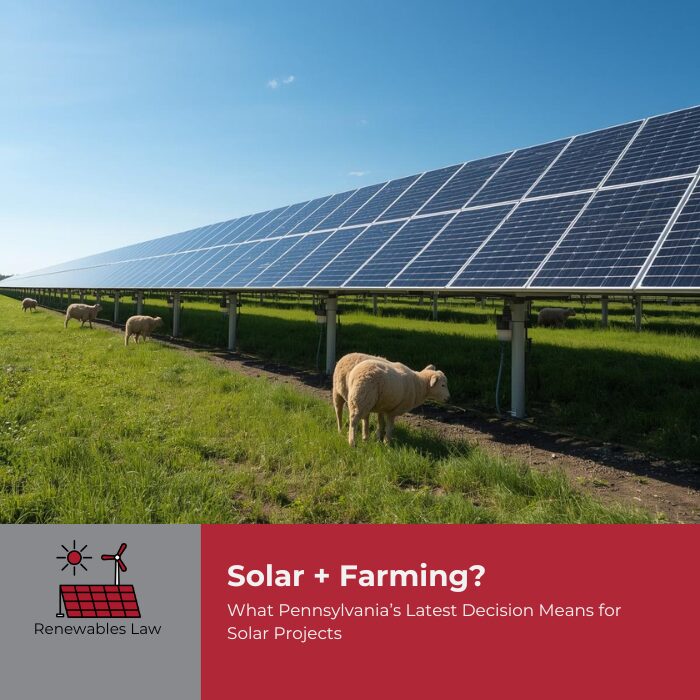
Agrivoltaics involves co-locating both solar panels and agriculture on the same land maximizing the use of the land within the same footprint. Many municipalities have specific solar ordinances embracing the use of agrivoltaics. A common agrivoltaics use includes sheep grazing the land under the solar arrays eliminating the need to use machinery to trim vegetation while also providing a feeding source. However, many municipalities do not specifically provide for agrivoltaics, if they provide for solar uses at all.
Pennsylvania’s Commonwealth Court recently considered whether a solar farm proposing the use of agrivoltaics should be permitted in an Agriculture District that restricted non-agriculture uses to no more than five (5) acres. In West Lampeter Solar 1, LLC v. West Lampeter Township Zoning Hearing Board, 76 D.C. 2025 (January 15, 2026), the ordinance did not define solar, solar farm or agrivoltaics. The applicant sought a special exception for an “agrivoltaics solar farm” to be sited on approximately 25 acres. The applicant argued that the project was agricultural and should not limited to the five (5) acres because it would utilize sheep to graze below the solar arrays.
In considering the special exception application, the zoning hearing board analyzed common definitions for terms including agriculture and agrivoltaics. The board concluded that the solar array was the principal use of the project and that grazing sheep below the solar panels would be an accessory use. The board denied the special exception because the principal use was not agricultural and the proposed site exceeded five (5) acres. The trial court affirmed the board’s denial of the project.
On appeal to the Commonwealth Court, it was noted that zoning ordinances “are to be liberally construed to allow the broadest possible use of land[.]” West Lampeter at 10 (citation omitted). The objective of ordinance interpretation is determine the governing body’s intent. A zoning board’s interpretation of its own “ordinance is entitled to great weight and deference[.]” Id. at 11. Looking additionally to the definition of ‘agricultural operation’ as provided in the Municipalities Planning Code, the Commonwealth Court concluded that “there must be a connection between the technological advance and the preparation of the agricultural products.” Id. at 15. The Court held that the generation of electricity from the solar arrays does not advance the preparation of the proposed agriculture use; i.e., sheep grazing. The Commonwealth Court upheld the board’s denial holding that a finding that agrivoltaics does not constitute an agriculture use was not unreasonable.
While the Commonwealth Court ruled in this case that agrivoltaics did not constitute an agricultural operation, that does not spell doom for all agrivoltaics proposals. The issue in West Lampeter concerned a municipality that did not provide for solar or agrivoltaics by ordinance. The decision in West Lampeter would not effect projects proposed in municipalities that permit solar or agrivoltaics. To the extent that a municipality does not provide for such uses, then caution must be utilized when determining the siting of a project to ensure that it can otherwise meet the zoning requirements without reliance on an argument that the solar project is agriculture just because agrivoltaics would be proposed. Arguably the decision does not appear to foreclose a finding that an agrivoltaics proposal could not be an agricultural use if the solar array would assist in the preparation of an agriculture product. In the West Lampeter case, sheep grazing did not meet the required nexus.
Since every case requires a unique analysis, it is imperative that you speak to an attorney to discuss your needs. The attorneys at MPL Law Firm, LLP, are experienced in zoning and land development are available to discuss the particulars of your specific project.
About the Author