

Forward Triangular Merger
A forward subsidiary merger, or a forward triangular merger, can offer liability protection when acquiring another company. This merger type is often compared with a reverse triangular merger and is only one of the many acquisition strategies available.
While it poses multiple benefits, like tax deferrals, consider the drawbacks when adopting this method. This article should serve as your guide on how forward triangular mergers work, when they’re best for your company and what alternatives you can consider.
What Is a Triangular Merger?
To understand forward triangular mergers, you should first know what triangular mergers are. A triangular merger is a merger between three entities:
- The parent company
- A merger subsidiary
- The target company to be acquired
Subsidiaries are companies owned by another business, a parent company, which owns more than half of the subsidiary’s stock. Although a parent company owns most, if not 100%, of the stock, the subsidiary remains a separate and distinct entity from the parent company.
Merger subsidiaries are typically special-purpose entities. They usually have no employees or independent operations and are created solely to carry out the merger. The parent company forms the subsidiary, which then serves as the legal vehicle for acquiring the target company.
Triangular mergers are indirect mergers because the parent company doesn’t directly acquire the target company. Whether a triangular merger is the forward or reverse type depends on which entity — the target or the subsidiary — survives at the end of the merger.
What Is a Forward Triangular Merger?
A forward triangular merger indirectly acquires another company, and the target company ceases to exist in the end. Say your company has Company A and plans to acquire Company B. Company B will merge into Company A as one entity, where Company B’s assets and liabilities are transferred into Company A. Your original subsidiary company survives the merger.
Forward vs. Reverse Triangular Merger
In a forward triangular merger, the target company disappears and the subsidiary survives. Companies often use this form when they want to keep the acquired business legally separate from the parent while consolidating under a dedicated subsidiary.
In a reverse triangular merger, the merger subsidiary disappears and the target company survives. The target becomes a subsidiary of the parent company, and all its assets, contracts and licenses remain intact in the surviving entity. Companies may prefer this structure when the goal is to preserve the target’s legal identity, such as maintaining permits, contracts with change-of-control clauses or brand continuity.
Using the previous companies, if Company A acquires Company B, the resulting company would be Company B. Your original subsidiary would cease to exist, and Company B would become the parent company’s subsidiary.
Benefits and Drawbacks
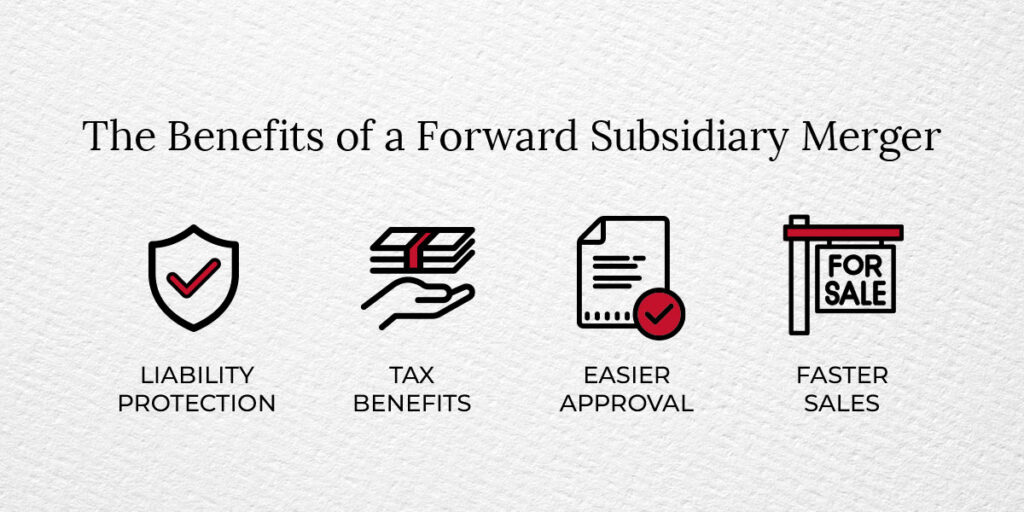
The benefits and drawbacks of a forward subsidiary merger determine whether it’s suitable for your company. These benefits include:
- Liability protection: Your parent company is not directly acquiring the target company — your subsidiary is. If liability issues occur, your subsidiary may be held accountable, not the parent company. In contrast, direct mergers combine two or more businesses, where all assets and liabilities are transferred to the new resulting entity. Old entities or companies will cease to exist, offering no separation or protection for the parent company.
- Tax benefits: Forward triangular mergers can qualify for tax deferral if the right balance of cash and stock is used and the transaction meets certain requirements. For instance, instead of purchasing the target company’s stock for a $100 cash price, you might offer $30 cash with $70 voting stock. The appropriate balance lets you defer tax payments on the stock, while the cash portion is taxed immediately. However, if too much cash is used, the deal could lose its tax-advantaged status.
- Easier approval: Direct mergers may need approval from the parent company’s shareholders. Since the parent company is the only shareholder of the subsidiary, and the subsidiary is the one acquiring the new company, it can be easier to approve and push through with the merger.
- Faster sales: Since the acquired company is only a subsidiary, the parent company can easily sell the acquired company if the opportunity arises.
Apart from the benefits, consider these drawbacks:
- Additional costs: Establishing and maintaining a subsidiary can pose additional costs and complicate the process.
- Contract and licensing renewals: Some contracts and licenses require permission from involved parties before they can be transferred to your subsidiary. Refusals can hamper the deal, while term changes may cause additional fees.
Should You Opt for a Forward Triangular Merger?
Whether you should choose a forward triangular merger depends on your company’s goals. Triangular mergers can lessen liability issues while still allowing you to acquire additional products or services. Forward triangular mergers may pose tax benefits, but can be challenging if contracts or licenses get in the way. A reverse triangle merger may offer a smoother transition, but can also be more costly.
Whatever acquisition method you use, it should involve thorough planning and analysis. One of the main reasons deals fall apart is a lack of a strong integration strategy. You can also avoid illegal mergers by keeping Section 7 of the Clayton Act in mind. No merger and acquisition method can be ideal if the result leads to significantly less competition or a monopoly.
Other Merger and Acquisition Types
Mergers and acquisitions can be classified in different ways. One way to classify them is based on the legalities of the transaction. Here are other merger types in parallel with triangular mergers:
- Statutory mergers: Statutory mergers merge two companies, with one company becoming the surviving entity while the other ceases to exist.
- Parent-subsidiary merger: As the name suggests, this is the merger between a parent company and a subsidiary. An upstream merger pertains to a subsidiary merging with its parent company, while a downstream merger is when a parent merges into its subsidiary.
- Multientity merger: Multientity mergers involve three or more companies. They involve negotiations with multiple parties and have more complex legal and financial considerations.
Why Trust MPL Law
At MPL Law, we pride ourselves on our long-term, trustworthy relationships with our clients, helping them with legal matters, whether they need help with corporate issues, criminal cases, estates or contracts. As a full-service law firm in York, we cater to our clients’ changing needs, with our major services including:
- Real estate law: Our real estate attorneys can offer professional representation in legal matters related to buying and selling properties in York.
- Business and commercial law: Our business attorneys can help you draft and examine contracts to ensure compliance.
- Estate planning: Our estate planning lawyers can guide you as you make important life choices regarding your estate.
- Municipal law: Our team can provide legal counsel to assist you in your everyday governance.
- Family law: Our attorneys have extensive experience in family law and can help you adopt a new family member or navigate divorce and custody issues.
- Criminal defense: Our criminal defense attorneys have over 40 years of experience and can help you get the best possible outcome for your situation.
Determine the Best Acquisition Strategy With MPL Law
Various merger and acquisition types pose differing opportunities. MPL Law can help you identify the best strategy for your company so you can grow your business smoothly and cost-effectively. Whether you want to take advantage of the tax benefits of a forward triangular merger or are looking for more options, our experienced attorneys can help you out. We work with many different business types, big or small, across various industries. Schedule a consultation today to get started.

Leave a Reply