

A Handshake Is Not a Contract—Especially When the Bill Comes Due
Written by James Sanders
Oops Files, Part 2:
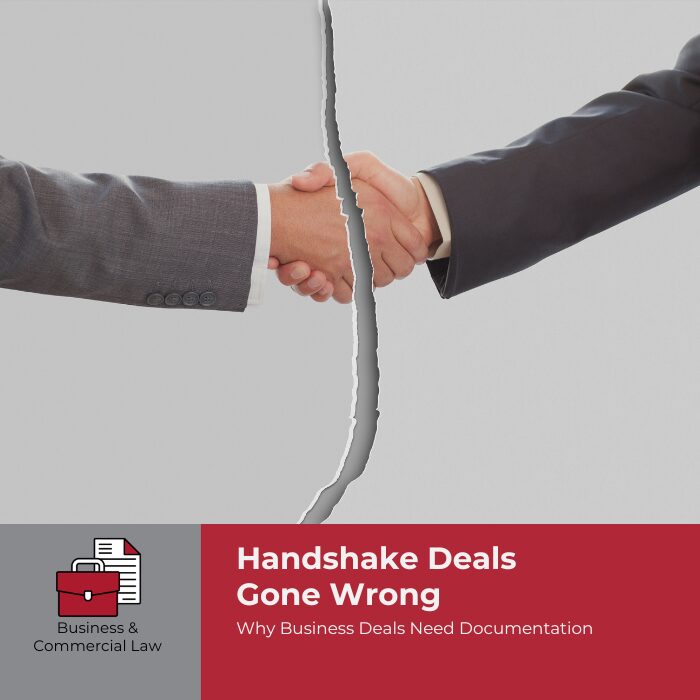
Business is built on relationships. A handshake can signal trust, momentum, and a shared expectation that both parties will do what they say they will do. But a handshake is not a substitute for making sure the parties actually agree on the same deal.
Many business disputes begin with a conversation that seemed clear at the time: “We will take care of you,” “You will have the territory,” “We will split the profits,” or “We will work out the details later.” The problem is not usually bad faith at the outset. It is that people remember conversations differently, circumstances change, and the “details” turn out to be the terms that matter most.
A short, well-prepared agreement is not a sign of distrust. It is a business tool that protects the relationship by putting the parties on the same page before money is spent, services are performed, or expectations become entrenched.
Where Handshake Deals Break Down
Informal arrangements often leave important questions unanswered:
- What exactly is each party required to provide, and when?
- How is compensation calculated, invoiced, and paid?
- Who bears costs, delays, shortages, or unexpected changes?
- Is the relationship exclusive, and if so, in what territory, market, or product line?
- Who owns work product, customer information, confidential information, and intellectual property?
- How long does the arrangement last, and how can either party end it?
- What happens if performance is late, incomplete, or disputed?
- Is someone signing personally, or on behalf of a properly identified business entity?
Those issues may seem unnecessary when everyone is optimistic. They become essential when the business relationship is under stress.
The “We’ll Work It Out” Problem
The phrase “we’ll work it out” is often a warning sign. It may be appropriate for minor operational matters that genuinely cannot be determined in advance. It is not a sound approach to core deal terms.
Each side may believe it has a perfectly reasonable answer. Without an agreement, however, the business may be left to resolve a preventable dispute after the relationship has already deteriorated.
Documentation Is a Relationship Tool
A useful agreement does not need to be unnecessarily long or complicated. It needs to address the business deal clearly and in a way that the people responsible for carrying it out can understand.
At a minimum, owners and management should consider documenting:
- The parties and their legal capacity to enter the arrangement
- The scope of work, goods, rights, or responsibilities being exchanged
- Payment terms and the process for resolving billing issues
- Confidentiality, ownership, and permitted use of business information
- Insurance, indemnity, and risk-allocation provisions where appropriate
- Term, renewal, termination rights, and post-termination obligations
- Dispute-resolution procedures and the governing law or forum
The goal is not to negotiate every imaginable disaster. The goal is to identify the terms most likely to matter and decide them while the parties are aligned. Before your business enters its next significant relationship, whether with a customer, vendor, partner, employee, consultant, lender, or investor, ask one question:
“If this relationship ended badly six months from now, would our written record clearly show what we agreed to do?”
If the answer is no, the time to address it is now, while the handshake still has its intended value: the beginning of a strong business relationship, not the evidence in a later dispute.
About the Author