

Supply Chain Risk Just Changed for Renewable Energy Developers
Written by Katelin Carter
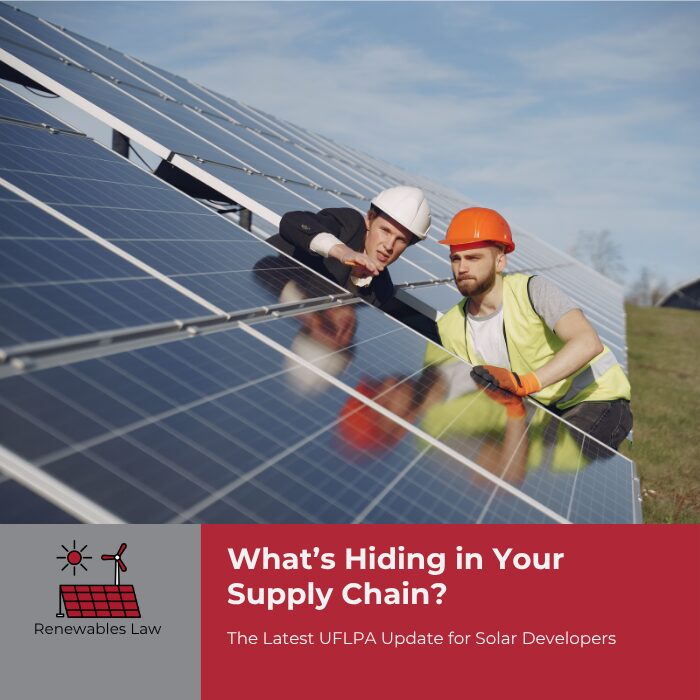
Changes to EPC Contracts: UFLPA Entity List Grows by 43
On August 3, 2026, the Department of Homeland Security (“DHS”) added 43 companies to the Uyghur Forced Labor Prevention Act’s (“UFLPA”)’s entity list (the “Entity List”), marking the largest single expansion since the UFLPA took effect and the first expansion since January 15, 2025. The change brought the total list to 187 entities, roughly a 30% jump. All 43 were added on one of two grounds: sourcing material from Xinjiang, or working with the Xinjiang government to recruit, transport, transfer, harbor, or receive Uyghurs, Kazakhs, Kyrgyz, or members of other persecuted groups out of the region. Forty-one entities were added under the sourcing category and four under the labor-transfer category, with two entities appearing in both categories.
Why does this matter?
This matters for renewable energy developers because these new entries routinely appear in Engineering, Procurement and Construction (“EPC”) contracts, namely: transportation infrastructure and construction materials, nonferrous and precious metals (copper, molybdenum, gold, aluminum), titanium, lithium, and cotton textiles, among others.
Many of these products ultimately find their way into common renewable energy project components, including racking systems, electrical equipment, battery materials, and other construction inputs. If your projects involve any of these inputs and any tier of your supply chain runs through China, this update could have an impact on your project.
The legal exposure:
The foundation for the prohibition is Section 307 of the Tariff Act of 1930, codified at 19 U.S.C. § 1307. Any goods “mined, produced, or manufactured wholly or in part in any foreign country by…forced labor” are barred from entry into the United States.
The Uyghur Forced Labor Prevention Act, Public Law 117-78, then sharpens that prohibition by directing Customs and Border Protection to apply a rebuttable presumption that goods are made with forced labor, and therefore prohibited from entry, if they were mined, produced, or manufactured wholly or in part in Xinjiang, or produced by an entity on the Entity List. The importer bears the burden of overcoming that presumption.
The “wholly or in part” language is what gives the prohibition its reach. The ban isn’t limited to goods made entirely by a listed company. Say, for example, you buy solar panels from a manufacturer with no ties to Xinjiang and a clean compliance record, but the polysilicon inside those panels came from a listed producer that appears several suppliers back in the chain. Even though your direct supplier is clean and that polysilicon is only one component, the entire shipment may be subject to the UFLPA’s rebuttable presumption and can be detained at the port unless the importer can satisfy Customs and Border Protection’s evidentiary requirements. A detention at the port can trigger significant project delays, storage costs, liquidated damages exposure, and financing complications even where the developer was unaware of the affected upstream supplier. Only verifying the companies you directly procure materials from is no longer enough. Many supply and EPC contracts already include UFLPA compliance clauses, so when a new company lands on the list, you may suddenly be in breach of, or owe notice or remediation obligations under a contract you signed long ago, even though no law has changed.
The practical response to this update is a review of your subcontractors and material sources, not just your direct vendors, alongside a look at the compliance and flow-down provisions in your active contracts. The full updated list is available on DHS’s UFLPA Entity List page. If you have questions about how this update might affect your development plans or ongoing contracts, we encourage you to reach out to MPL Law. We’re happy to help you assess your exposure and next steps.