

When Privately Owned Property Endangers the Public
Written by Laurel Bennett, Law Clerk
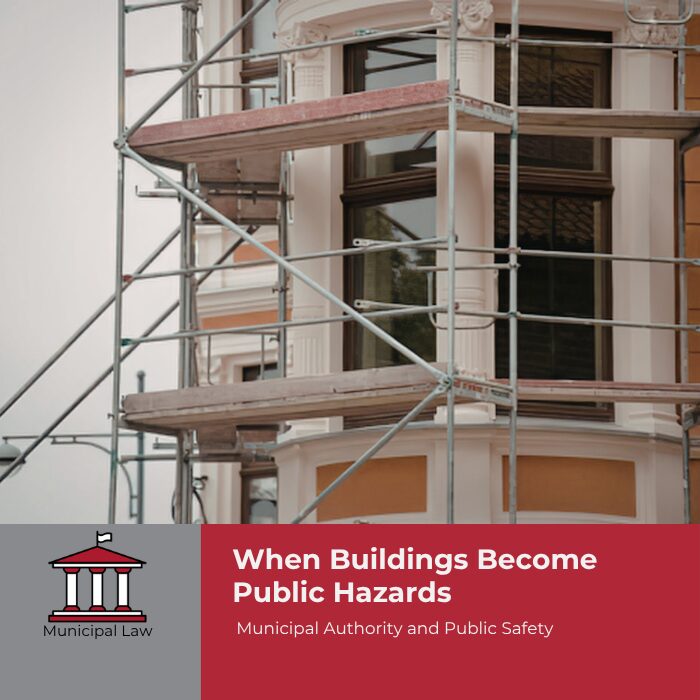
Many questions can arise when a privately owned structure poses an imminent public safety hazard. Elizabeth Borough v. Kenneth A. Kolodziej and Lori A. Kolodziej (Commonwealth Court, filed April 2, 2026) considers this very scenario.
The Kolodziejs owned a vacant two-story commercial structure in Elizabeth, Pennsylvania on a heavily travelled road by both pedestrians and vehicles. The structure featured brick-masonry façade, wood framed floors, and a metal roof. Additionally, the structure shared side walls with two adjacent buildings.
On June 3, 2025, the front façade partially collapsed onto the sidewalk and the street. On the same day, Elizabeth Borough (Borough) sent its structural engineer, Laura Branthoover to investigate. She deemed the building to be a public safety hazard and believed it was in imminent danger of further collapse. Also, the Borough’s Building and Code Officer, Robert Vitous, inspected the structure. He issued a detailed Inspection Report detailing the condition of the structure. Mr. Vitous noted an array of issues, such as the area being full of debris and there being no HVAC. Mr. Vitous had previously cited the Kolodziejs for façade violations in March of 2025. The street was blocked indefinitely, and businesses on the block could not open due to the public safety hazard.
On June 4, 2025, Ms. Branthoover completed an engineering assessment report (Engineering Report). She once again recommended demolition of the structure. For example, she detailed the fact that the structure’s interior was now exposed to the elements and that there was cracking and displacement in foundation walls. In addition, Ms. Branthoover concluded that the structure was in violation of provisions of the 2021 International Property Maintenance Code (IPMC), which the Borough adheres to.
The Kolodziejs hired James R. Ventura on June 4, 2025 to evaluate the structure. In contrast to Ms. Branthoover and Mr. Vitous, Mr. Ventura did not believe the structure posed a public safety hazard. Instead, he provided recommendations to prevent the structure from collapsing, such as placing a temporary support on the roof framing and removing deteriorated dry wall. The Kolodziejs completed the recommendations. Ms. Branthoover amended her Engineering Report to address Mr. Ventura’s report. Additionally, the Kolodziejs hired a second structural engineer to inspect the structure.
On June 6, 2025, the Borough filed a Petition for Emergency Demolition (Emergency Petition) in the trial court. The Emergency Petition emphasized the structure’s architectural flaws and its imminent public safety hazard. In particular, the Emergency Petition sought an order granting the Borough permission to demolish the building and lien the property for the costs of doing so.
At the trial court hearing on June 10, 2025, the Kolodziejs’ structural engineers were absent, yet there was no request for a continuance of the hearing. Ms. Branthoover testified and largely focused on the fact that she believed the structure had been compromised. Additionally, Ms. Branthoover disagreed with Mr. Ventura’s recommendations to improve the stability of the structure. She believed the structure would be unsafe even with the improvements.
Importantly, the Kolodziejs were aware of issues with the structure. The Borough Manager, Scott Craigshead, indicated that the Kolodziejs successfully appealed a demolition order in 2015. Mr. Craigshead noted that he never saw the Kolodziejs making improvements to the building, nor did he observe any applications for building permits.
The trial court declared the structure a nuisance, ordered the immediate demolition of the building, and ordered that a lien be placed on the property for the costs related to the demolition. Mr. Vitous’s and Ms. Branthoover’s explanations of the risk of imminent collapse were highly influential.
The Kolodziejs appealed to the Commonwealth Court and presented three issues: (1) whether they were denied due process of law because they were not afforded adequate notice and a meaningful right to be heard; (2) whether substantial evidence supported the trial court’s determination that the building was a nuisance and posed an imminent danger; and (3) whether the trial court erred in admitting the testimony and report of Ms. Branthoover.
As for the first issue, a central component of the Kolodziejs’ argument that they were denied due process of law is that their expert witnesses could not attend the trial court hearing. However, their counsel did not expressly ask the trial court for a continuance. The Commonwealth Court disagreed with the appellants on this issue. Particularly, Pennsylvania Rule of Civil Procedure 216 (Grounds for Continuance) requires a formal request for a continuance from a party, which did not occur. Furthermore, a failure to request a continuance causes a waiver of any due process violation argument on appeal.
Next, as to whether substantial evidence supported the trial court’s demolition order, the Commonwealth Court considered an array of evidence in the trial court’s record. Specifically, there were ample visual observations, measurements of the structure, and photographs showing the interior and exterior of the structure. Also, the City’s building inspector had personal familiarity with the structure and was aware of proper building safety standards. The Commonwealth Court concluded that this evidence was ample to require the granting of the Emergency Petition.
Lastly, the Kolodziejs argued on appeal that the trial court erred in admitting the testimony and Engineering Report of Ms. Branthoover because she only spent ten minutes on the property. However, Pennsylvania Rule of Evidence 703 states that “an expert may base an opinion on facts or data in the case that the expert has been made aware of or personally observed.” Ms. Branthoover presented photographs to prove she completed an interior inspection of the building. Additionally, she completed these inspections multiple times a week. The Commonwealth Court deemed the testimony and Engineering Report of Ms. Branthoover to be proper, ultimately affirming the order of the trial court to grant the Emergency Petition to demolish the building and lien the property for the costs of doing so.
A major lesson from this case is the importance of adhering to any applicable Property Maintenance Codes and keeping up with general structural repairs before a problem arises. If the Kolodziejs had adhered to the IPMC in the first place, the subsequent structural problems and the Emergency Petition could have potentially been avoided entirely.