

Beyond “I Do”: Marriage Money and Legacy Series
Written by Akshaya Senthil Kumar
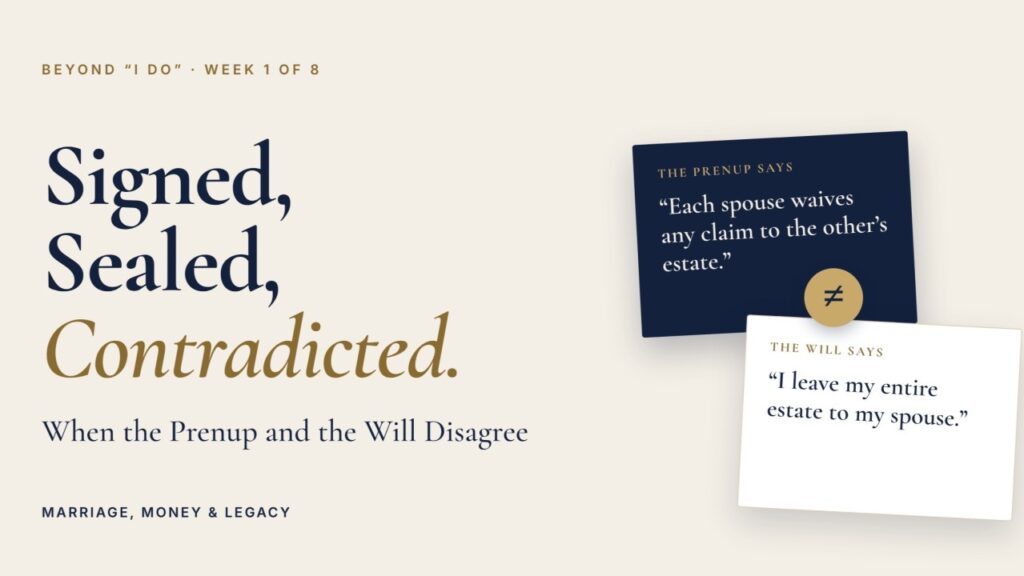
Signed, Sealed, Contradicted.
Two documents. Two lawyers. One very expensive disagreement.
Most estate disputes don’t begin with bad intentions. They begin like this:
Susan is walking down the aisle for the second time, and this time she’s planning ahead. She owns a family business that she hopes her two adult children will one day take over and run. So before the wedding, she and her fiancé, Mark, sign a prenup: if they divorce, each walks away with what they brought in, and each waives “all rights” in the other’s property. Everyone shakes hands feeling good.
Fast-forward ten years. Susan updates her will, this time with a different lawyer. Nobody thinks to pull the prenup out of the drawer. The new will leaves Mark a generous share of the estate, and the family business, the very thing the prenup was built to protect, gets swept into “everything else I own” and split among all her heirs. Tucked away in a file somewhere, her old 401(k) still names her first husband as beneficiary, on a form she signed decades ago and never looked at again. Chaos, right?
Here’s the twist: every one of these documents is perfectly valid. The prenup. The will. The 401(k) form. The problem isn’t any single document. It’s that no one ever laid them side by side and read them together. So when Susan dies, her children, Mark and her first husband each have a plausible claim to something. That is how a loving, well-intentioned plan becomes a lawsuit.
Time to put on your issue-spotting hat. What problems do you see?
1. The waiver that was never really made
Susan’s prenup, drafted with divorce in mind, has Mark give up “all rights in Susan’s property.” It sounds airtight, until you notice what’s missing: a single word about death. So, when Susan dies, Mark’s lawyer makes a simple argument: Mark gave up his rights as a husband, not his rights as a widower.
Why it matters: Most states guarantee a surviving spouse a minimum share of the estate, no matter what the will says. In New York, that is the greater of $50,000 or one-third of the net estate, and it can reach certain assets that pass outside the will (EPTL 5-1.1-A). A spouse can waive that right in a prenup, but only in a writing signed and acknowledged with the same formality as a deed. When the language is vague, a court is left to reconstruct what each party meant to give up, long after Susan can explain.
If you mean to waive inheritance rights, say so precisely and in writing. Vague language is an open invitation to litigate.
2. The will that quietly rewrites the deal
Let’s saythe prenup gives Mark sole control of a joint brokerage account if they divorce, and nothing more. Years later, Susan’s new will leaves him a substantial share of her estate, far more than the prenup ever contemplated. Her children assumed the prenup had “locked in” their inheritance. It hadn’t. A prenup that speaks only to divorce sets no limits on what Susan may leave Mark at death, and her will is free to be more generous.
The problem cuts the other way too. Suppose the prenup promised Mark a paid-off house at Susan’s death, but her will leaves the house to the children. Now Mark must sue the estate to enforce a promise everyone thought was settled.
Simply put – A prenup is a promise; a will is an instruction. When the two collide, someone ends up in court.
3. The divorce that didn’t finish the job
Say Susan and Mark had divorced instead. In many states, divorce automatically cancels the gifts and appointments you made to your ex in your will – so Mark wouldn’t inherit, and wouldn’t serve as executor, even if Susan never updated a thing (in New York, that is EPTL 5-1.4). Reassuring, right? Only partly.
That automatic cancellation doesn’t reliably reach every asset – and ERISA retirement plans are the big exception (more on that next week). Plenty of ex-spouses have walked away with a 401(k) simply because nobody remembered to change the beneficiary form after the divorce.
A divorce decree ends the marriage. It doesn’t always end the paperwork.
Same family, different state, different result
Where you live when you die matters more than most people realize. Your domicile at death generally decides which state’s inheritance and death-tax rules govern your personal property; real estate usually follows the law of the state where it sits. Move across a state line, and your plan may be read under a rulebook its drafters never considered.
Take Pennsylvania. If you die without a will and all your children are also your spouse’s children, your spouse takes the first $30,000 plus half of the residuary estate. But if even one child is from a prior relationship, your spouse takes only half of the residuary estate, with no $30,000 off the top (20 Pa.C.S. § 2102). A second marriage, in other words, quietly shrinks the surviving spouse’s share.
The tax picture is just as particular. Pennsylvania has no stand-alone estate tax, and life insurance proceeds are exempt (72 P.S. § 9111). Instead, it imposes an inheritance tax that depends on who inherits: 0% to a spouse, 4.5% to lineal descendants, 12% to siblings and 15% to everyone else (72 P.S. § 9116).
Food for thought: An estate plan designed around one state’s rules may not carry over the way you intended. Before you move, make sure your plan moves with you.
What I tell clients and colleagues
- Put the prenup and the estate plan on the same desk, at the same time, ideally with one advisor reading both.
- Ask whether the prenup speaks to death and disability as clearly as it speaks to divorce. Many don’t.
- Pull every beneficiary form (401(k)s, IRAs, life insurance, accounts from old jobs) and confirm who is actually named.
- Revisit everything after each major life event: a marriage, a divorce, a new child or grandchild, a business sale, or a move to a new state or country.
So here’s my question: if you pulled out your documents today, or your client’s, would they tell the same story, or would they argue with each other?
About the Author