

It’s Just a Driveway: Commonwealth Court Slams the Brakes on “Land Development” Creep
Written by Charles Rausch
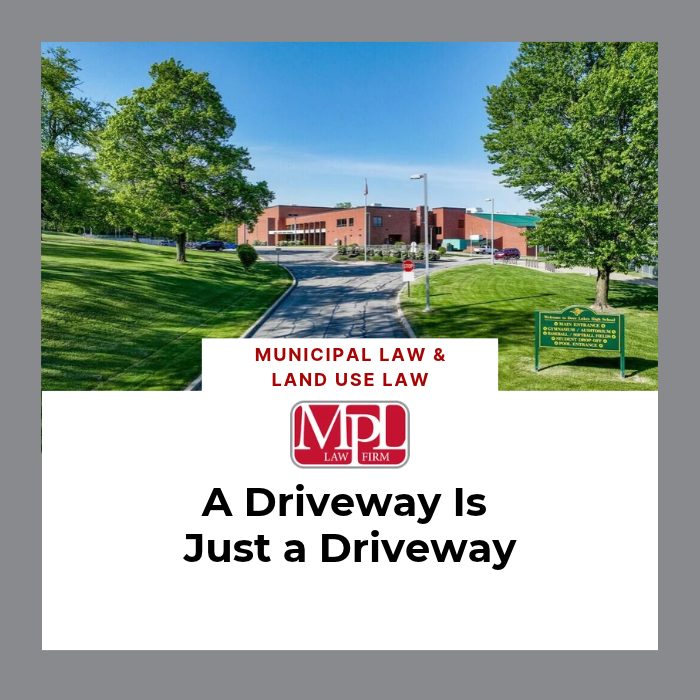
Smith v. York Township ZHB draws a bright line between a new access drive and a full-blown land development plan
Does every new curb cut or access drive trigger a full-blown land development review? According to the Pennsylvania Commonwealth Court, the answer is a resounding no. In Smith v. York Township Zoning Hearing Board et al., (Pa. Cmwlth. Ct., 939 C.D. 2025, 10/10/2026) (2026 WL 3118541), the Dallastown Area School District obtained a zoning permit for a second access drive to ease congestion and safety concerns.
A neighbor challenged the permit, arguing that the drive was a “land development” requiring a plan under the Township’s Subdivision and Land Development Ordinance (“SALDO”), whose definition mirrors the Pennsylvania Municipalities Planning Code (“MPC”). The zoning hearing board said no plan was needed. The trial court disagreed, reasoning that the drive was a “large-scale development of land” because it implicated stormwater management, queuing, and other legitimate governmental concerns. The Commonwealth Court reversed the trial court and held that the access drive did not require a land development plan.
The key question was scale—and “large scale” means large scale. Relying on the Pennsylvania Supreme Court’s decision in Upper Southampton Township v. Upper Southampton Twp. Zoning Hearing Bd., 934 A.2d 1162 (Pa. 2007), which held that a billboard was not a land development, the Court explained that the MPC targets development on a “large scale,” involving issues such as the location and bulk of buildings and other structures, intensity of use or density of development, streets, ways and parking facilities, common open space, and public facilities. “Land development” generally refers to the construction of residences or buildings that raise concerns about municipal services such as water management, streets, and public convenience. The access drive did not come close: it did not create additional traffic but merely redirected it, and any impact on municipal services was negligible. For municipal officials and developers alike, the lesson is clear—before demanding (or preparing) a land development plan, ask whether the project truly brings the kind of large-scale impacts the MPC was designed to address. A driveway, it turns out, is just a driveway.
Determining whether a proposed improvement qualifies as land development requires a careful review of the applicable ordinance, project scope, and relevant case law. MPL Law Firm’s Municipal Law attorneys help municipalities, property owners, and developers navigate zoning and land development requirements. Contact MPL Law Firm to discuss how these requirements may apply to your next project.
About the Author
