

Will Pennsylvania Tax the Battery?
Written by Andrew Miller
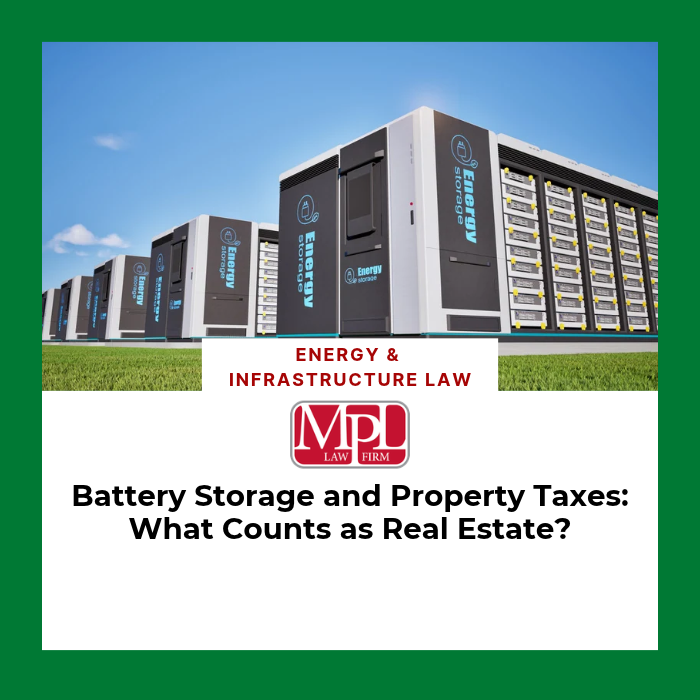
Battery energy storage projects require significant upfront investment, but not every dollar invested necessarily translates into taxable real estate. In Pennsylvania, the distinction between taxable property improvements and exempt machinery and equipment can have a meaningful impact on a project’s long-term operating costs. For BESS developers, understanding that distinction and documenting it before an assessment is issued should be part of the development process, not an afterthought.
The issue is not whether the project has value. It is what counts as real estate.
A utility-scale BESS can represent a substantial capital investment, but Pennsylvania property tax does not automatically follow total project cost. Local real-estate tax reaches taxable real estate. The critical development question is therefore component-by-component: what is land or a taxable improvement, and what is machinery or equipment excluded from the assessment base?
That distinction matters at every stage. If an assessor captures battery and electrical-equipment value in the real-estate assessment, the project can face an operating-cost increase that was never reflected in the bid model, offtake economics or financing case. Because Pennsylvania has not enacted a BESS-specific rule, developers should expect the answer to depend heavily on county practice, project configuration and the record they create.
The statutory starting point favors a component approach
Section 8811 of the Consolidated County Assessment Law identifies taxable real estate, including land and buildings permanently attached to land or connected with utilities. But the same section excludes “machinery, tools, appliances and other equipment” contained in a mill, mine, manufactory or industrial establishment from the real-estate value used for taxation. That exclusion is the central statutory basis for treating the working equipment of a BESS as outside the real-estate assessment.
For a developer, the practical argument is straightforward: a battery container is not valuable because it shelters empty space. Its function is to house an integrated operating system that stores, conditions and dispatches electricity. Batteries, racks, power-conversion systems, inverters, transformers, switchgear and controls should be documented as functional project equipment. The harder questions are whether the facility qualifies as an “industrial establishment” and whether a container or enclosure will be viewed as equipment, a building, or some combination of both.
A practical classification map
| Project component | Likely position | Development implication |
| Land | Taxable real estate | Model the land assessment and any change in use. If enrolled in Clean and Green, separately analyze preferential-assessment consequences and rollback exposure. |
| Buildings and conventional site improvements | Generally taxable | Separate ordinary structures and site work from operating equipment in contracts, cost records and appraisals. |
| Battery modules, racks, inverters, transformers and controls | Strong machinery/equipment argument | Preserve equipment schedules, invoices, engineering narratives and evidence of function, replacement and removability. |
| Containers, foundations and concrete pads | Fact-sensitive | Design and documentation should distinguish shelter or support from the equipment’s operating function. Expect assessor scrutiny. |
| Solar-plus-storage integration | Potential allocation dispute | Track solar, storage, shared interconnection and site-work costs separately rather than relying on one bundled EPC number. |
What developers should do before the assessment arrives
✓ Underwrite a range, not a single answer. Run a base case that excludes operating equipment and a downside case that assumes some container, enclosure or equipment value is assessed.
✓ Create the evidentiary record during development. Maintain a component-level cost segregation, equipment schedules, one-lines, site plans, photographs and a short technical narrative explaining what each component does.
✓ Investigate the county early. Ask local assessment counsel or a qualified consultant how the county has treated comparable generation, solar, substation and storage assets. A preliminary conversation is useful, but it is not a substitute for appeal rights.
✓ Allocate risk in the documents. Address cooperation, information access, control of appeals, settlement authority and tax sharing in the lease, PILOT or host agreement, EPC package, acquisition documents and financing covenants.
✓ Calendar the appeal. Review the assessment as soon as it is issued. Preserve administrative and judicial deadlines, and avoid allowing an overstated first-year classification to become the project’s unchallenged baseline.
Bottom line
Pennsylvania law gives BESS developers a credible basis to exclude the project’s operating equipment from taxable real estate, but it does not give them a project-specific safe harbor. The opportunity is meaningful, and so is the classification risk. The best protection is to treat property tax as a development workstream: identify the taxable and excluded components, document the engineering and costs, test the county’s likely position, preserve appeal rights and make sure the deal documents place the risk where the financial model assumes it belongs.
Property tax classification can have lasting financial implications for battery energy storage projects. Understanding which components may qualify as exempt machinery and equipment, documenting project costs, and evaluating local assessment practices are important steps in managing that exposure. MPL Law Firm’s Energy and Real Estate attorneys help developers and project owners navigate the legal and property considerations involved in energy infrastructure projects. Contact MPL Law Firm to discuss property tax considerations and other legal issues affecting your next energy project.
About the Author
