

Pennsylvania’s Power Crunch Is Real. And Newsflash here: The State’s Own Data Says Solar Is the Fix!
Written by Andrew Miller
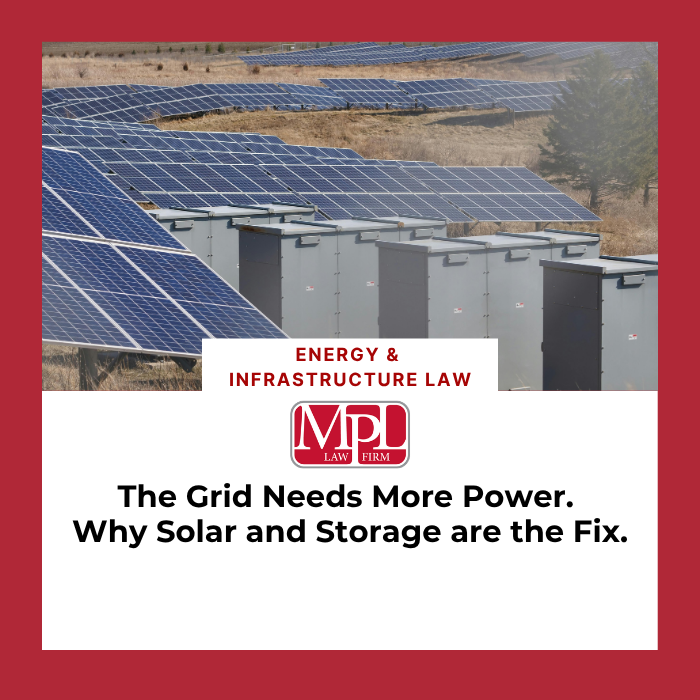
A new independent, PUC-commissioned grid study confirms what renewable developers have known for years: solar and battery storage aren’t a bet on politics. They’re the fastest, most buildable answer to keeping Pennsylvania’s lights on.
Here’s a number that should get every energy investor’s attention: 13.20.
That’s the projected 2030 loss-of-load expectation for the PJM grid under a plausible high-growth scenario. 132 times worse than PJM’s own reliability standard of 0.1. This means that in a worst-case (but entirely realistic) future, PJM customers could see the equivalent of 13 days of rolling outages in a single year. Even in PJM’s business-as-usual case, the grid still misses the reliability target nearly six-fold by 2030!
This isn’t a renewable-energy advocacy talking point. It’s the headline finding of “Assessing Electricity Resource Adequacy in Pennsylvania and PJM,” a September 2026 study that Synapse Energy Economics prepared for the Pennsylvania Public Utility Commission after the PUC’s 2024 Technical Conference on Resource Adequacy. The Commission asked independent modelers to stress-test Pennsylvania’s grid through 2040. What they found is a supply-demand collision driven in the worst-case scenarios by data center, but also equally concerning for the business-as-usual case where we do not see a data center explosion.
The Real Culprit Isn’t Renewables. It’s Load Growth.
The report is unambiguous that electricity demand, not clean energy policy, is what’s straining the system. In a hypothetical “No New Data Centers” scenario, which keeps the same resource mix as the base case, the grid’s reliability score comes in at 0.05, twice as good as the planning standard. Strip out the data-center surge, and the grid works. The problem is 200+ terawatt-hours of new, always-on load slamming into the system in a single year, not a shortage of coal plants.
Just as tellingly, the study finds that coal and gas-steam retirements are happening for reasons that have nothing to do with renewable mandates: aging equipment reaching end-of-life, and cheaper resources undercutting them economically — in every single scenario modeled, including the fossil-friendliest.
Solar and Storage Are the Grid’s Actual First Responders
If data centers are the problem, the report’s own numbers show exactly what the solution looks like, and it’s not what cable-news energy debates would have you believe.
- Pennsylvania’s leading near-term resource additions are solar and battery storage: 3 to 7 GW of each by 2030, more than any other resource category the state is projected to add in that window.
- The model’s own build-limit assumptions allow roughly four times more solar capacity to come online PJM-wide by 2030 than new gas because solar and storage projects simply move through permitting, procurement, and construction faster.
- When PJM needed an emergency fix, it turned to storage: its Reliability Resource Initiative, a one-time fast-track for shovel-ready reliability projects, selected 1.6 GW of battery storage for near-term deployment.
- Battery ELCC (capacity) values for 8- and 10-hour systems are rated at 65% and 74% respectively in the near term by PJM, rivaling many thermal plants as “real,” dispatchable capacity.
- Pennsylvania already leads all thirteen PJM states in its interconnection queue, with nearly 40 GW of generation — heavily weighted toward solar and storage, advancing through PJM’s reformed cluster study.
Federal interventions to keep old coal plants alive are explicitly temporary, 90-day emergency orders, renewed on a rolling basis, not a resource-adequacy strategy. Even with them in place, the report’s Reference and High Load scenarios still blow through PJM’s reliability standard. Policymakers know this is not the answer.
The Nuclear Hype Doesn’t Match the Timeline
Nuclear power gets a lot of airtime in the current energy debate, and it has a role to play. But investors should be clear-eyed about the timeline: the report’s modeling doesn’t bring any new nuclear generating capacity online until 2040. The very last year of the study period. That’s not a bridge to today’s data-center-driven crunch; it’s a generation away. Small modular reactors are similarly not assumed to be buildable until 2040. Meanwhile, solar and storage are interconnecting, permitting, and generating revenue today, and will keep doing so every single year between now and then.
The PJM electricity markets are currently operating under price caps implemented temporarily to keep electricity costs down. Those price caps are already predictably failing based on PJM’s inability to fill its capacity needs for 2027. It’s a doomed-to-fail stop-gap policy, not a solution.
What This Means for Capital
The AI race is a Trump-down mandate that is not going away. Trump has in a very savvy way recognized that re-branding is needed for the AI race to continue so he now calls it “superintelligence” not out for egotistical reasons as many believe, but because he has to in order for the U.S. to continue to be in the race. The Puc’s study just confirms in very clear terms that solar and storage are also integral to the AI or superintelligence race. A fact policymakers in Washington will come to terms on.
For developers and investors focused on Pennsylvania distributed generation and BESS assets, this report is a green light, not a caution flag. The state’s own commissioned analysis, produced by independent modelers for a regulator, not an advocacy group, shows that solar and storage are the resources actually being selected, actually being fast-tracked, and actually capable of closing the reliability gap that data centers are opening up. The fundamentals here are not political; they are physical and economic. Continued investment in Pennsylvania solar and storage isn’t a hedge against a possible clean-energy future — it’s a direct bet on the only near-term fix for a documented, quantified grid emergency.
The bottom line to me is that investors and developers in solar and battery storage need to stop talking about climate change and clean energy. That brand is an anchor, not an engine and no longer the primary reasons to build solar. Let’s all focus instead on the reality of the situation. Solar and storage are faster, cheaper and more reliable than any other option. The story is out. Now let’s go build it!
Pennsylvania’s changing electricity demand is creating new considerations for energy developers, investors, landowners, and project sponsors. If you are evaluating a solar, battery storage, or distributed-generation project in Pennsylvania, MPL’s Energy and Infrastructure team can help you navigate the legal and regulatory issues that can affect project development, including permitting, land use, interconnection, contracts, and project structure. Contact MPL to discuss your next energy project.
About the Author
