

Subdivision of Property Enrolled in Clean & Green
Written by Rob Davidson
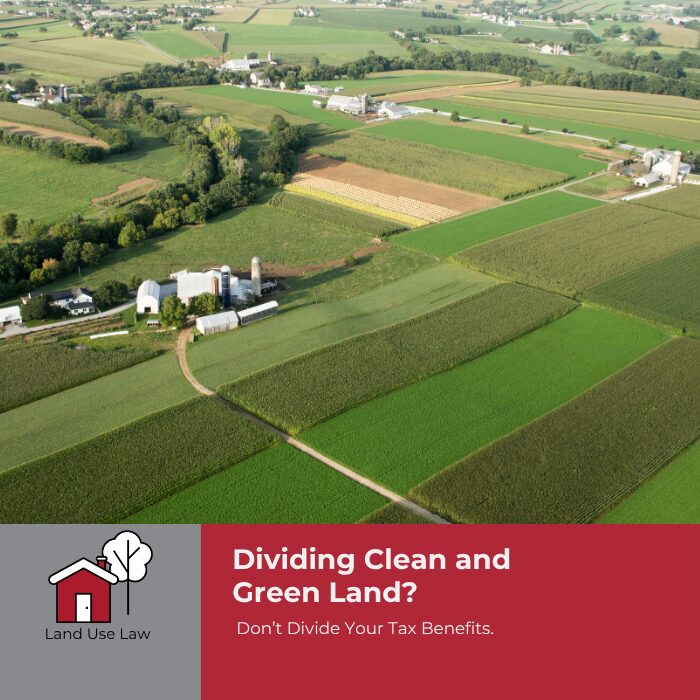
ACT 319, the Farmland and Forestland Assessment Act of 1974, often referred to as the Clean and Green Law, was designed to help farmers deal with escalating real estate values. This is a preferential property tax assessment program whereby land is taxed according to its agricultural use or timber value, rather than its highest and best market value. The Clean and Green Law is administered at the County Level, where each county may implement and interpret this Law differently.
To be enrolled in Clean and Green the property must fall within the eligibility categories of Agricultural Use, Agricultural Reserve, or Forest Reserve, generally be greater than 10 acres, and include eligible land uses. The Clean and Green law specifies eligible land uses.
The subdivision of enrolled property is permitted provided that it meets the program requirements. When considering the subdivision of enrolled property, it is important to obtain a copy of the landowner’s Clean and Green contract. There may be multiple deeds, and deed parcels that are subject to the Clean and Green regulations.
Before initiating any subdivision of property enrolled in Clean and Green a determination if the proposed subdivision will be a violation of the Clean and Green Law should be obtained from the County Assessment Office, which should be confirmed in writing. Additionally, confirmation should be obtained from the Assessment Office before recording any deeds for subdivided property enrolled in Clean and Green to make certain that this recording will not be an unexpected violation of the Clean and Green Law. Once a deed has been recorded there is almost no opportunity to correct any Clean and Green error.
If a subdivision results in a violation of the Clean and Green Law, the subdividing landowner is responsible for the violation, and is liable for payment of Roll-back taxes to the County. Roll-back taxes are calculated as the difference between use value taxes paid and the market value taxes that would have been due for a period of up to the seven years prior to the violation, with the current year prorated. A penalty of six percent interest per year on this difference is also assessed. If the property has been enrolled for less than seven years, Roll-back taxes and penalties are calculated based on the time of enrollment. The County may file a lien on the property for nonpayment of the Roll-back taxes and penalties.
The Clean and Green Law does permit the subdivision of enrolled property that will not result in any payment of the Roll-back taxes and penalties. The Law designates this as a “Separation”. A Separation is parcels that include an eligible land use and are generally 10 acres or greater. If the new parcel(s) and the remaining property continue to meet the requirements of the Clean and Green Law, no Roll-back taxes are due.
The Law provides for the subdivisions of less than 10 acres, which it designates as a “Split-Off”. A Split-off is a subdivision of 2 acres or less, but may be up to 3 acres for a residential lot if required by local regulations. A land owner is only permitted to subdivide one Split-off per year, and Split-offs can never exceed the lesser of 10 acres or 10% of the enrolled land.
A Split-off must be for eligible land uses and comply with the category requirements of Agricultural Use, Agricultural Reserve, or Forest Reserve, or be for the construction of a residential dwelling to be occupied by the person to whom the land is conveyed.
In a Split-off, Roll-back taxes and penalties, as provided for above, are due and are calculated based on the acreage being subdivided. A Split-off parcel will no longer receive preferential assessment and will be taxed at the market value. An attempted Split-off that does not comply with the act will result in Roll-back taxes and penalties on all enrolled acreage.
Taxing bodies have the option to forgive Roll-back taxes and penalties for a subdivision if the use of the land is changed for the purpose of granting or donating such land to a school district, a municipality including a county, a volunteer fire company or ambulance service, a religious organization for construction or regular use as a place of worship, including meeting facilities, parking facilities, housing facilities and other facilities which further the religious purposes of the organization, or a not-for-profit 501(c)(3) corporation, provided that, prior to accepting ownership of the land, such corporation enters into an agreement with the municipality wherein the subject land is located guaranteeing that it will be used exclusively for recreational purposes, all of which shall be available to the general public free of charge. In the event the corporation changes the use of all or a portion of the land or charges admission or any other fee for the use or enjoyment of the facilities, the corporation shall immediately become liable for all Roll-back taxes and accrued interest previously forgiven. This would require an agreement by the County, Municipality and School District where the property is located.
No Roll-back taxes are due if subdivided property is conveyed to a nonprofit corporation for use as a cemetery or for a trail for nonmotorized passive recreational use which does not exceed twenty feet in width and is available to the public for use without charge provided the remaining property still meets Clean and Green requirements.
Additionally, property deemed to be “Erroneously Enrolled Property” by the County Assessment Office is not subject to Roll-back taxes. This would include any portion of the property not devoted to eligible land uses. In order to avoid Roll-back taxes and penalties on the subdivision of Erroneously Enrolled Property this determination should be made prior to submission for approval of any subdivision plan.
It is important to note that if there is a violation of the Clean and Green Law of a Separation within 7 years of the subdivision, it is the landowner who is the owner of the property from which the Separation was subdivided that is liable for Roll-back taxes and penalties for both the subdivided parcel and the remaining property. For violations of a Separation 7 years or more after the subdivision, the landowner of the of a Separation is liable, and Roll-back taxes and penalties which are only due on subdivided parcel.
The Clean and Green Law is complex and the above is only a summary of requirements and penalties. Roll-back taxes and penalties for violations of the Clean and Green Law can be significant, often in the tens of thousands of dollars. If you are considering the subdivision of property enrolled in Clean and Green, it is important that you know and understand the requirements and potential impact it may have. Early consultation with professionals experienced in the subdivision of Clean and Green enrolled property is essential to ensure that unnecessary Roll-back taxes and penalties are not incurred.
About the Author