

The Intricacies of Zoning Laws
Written by Laurel Bennett
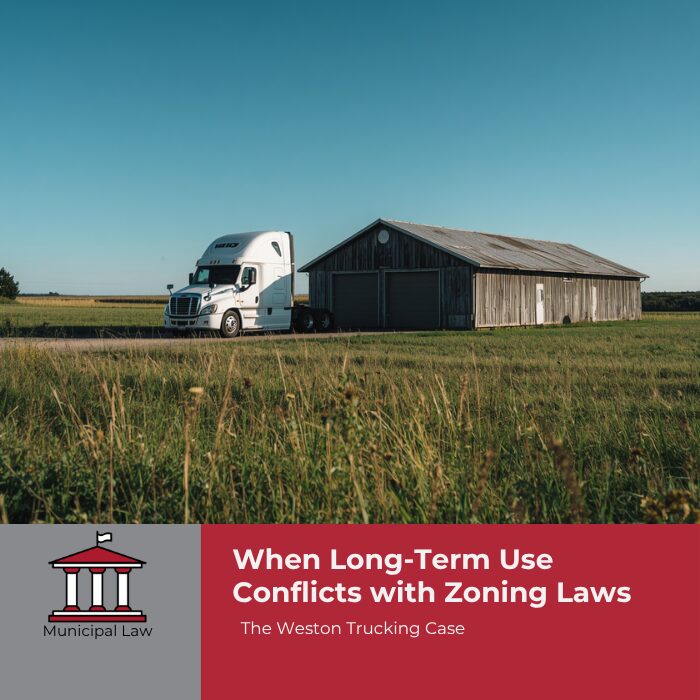
Zoning laws can be a highly complex topic. In Dean and Michelle Weston, t/d/b/a D & M Weston Trucking, LLC v. Hanover Township Zoning Hearing Board and Hanover Township (Commonwealth Court, filed April 6, 2026),the Westons quickly learned this.
The Westons reside in Hanover Township (Township), and their property is zoned as R-1 Rural Resident. They received an Enforcement Notice from the Township on September 2, 2020. This Enforcement Notice asserted that the Westons were running a commercial trucking business on their residential zoned property. The Westons appealed this notice from the Township because they believed the Township was previously accepting of the business, therefore claiming there was a variance by estoppel. Generally speaking, a variance by estoppel prevents the enforcement of a zoning code when the local government allowed a violation of the zoning code in the past.
On October 26, 2020, the Zoning Hearing Board (ZHB) completed a hearing on the Weston’s appeal where the Westons, several neighbors, and the Zoning Officer testified. Dean Weston testified that he built the truck garage in 2004. Additionally, he explained that he had the necessary approval and permitting from the now deceased Zoning Officer at the time, Mr. Reed. Mr. Weston got another permit in 2013 to do an add-on to the garage, and Mr. Reed knew about the garage being of commercial nature.
Michelle Weston also testified about their trucking business, which has been an expensive endeavor. She explained that they were open about their trucking activities and that they never received anything indicating the illegality of their business. Additionally, Ms. Weston testified that Mr. Reed told them that the trucking business was permissible on their property.
Ultimately, the ZHB concluded that the Westons violated the Township’s Zoning Ordinance by running their trucking business on their residential zoned property. At this time, the ZHB made no factual findings regarding the Westons’ variance by estoppel claim.
On January 15, 2021, the Westons filed a notice of appeal in the trial court. The ZHB continued to maintain that there were not enough factual findings to grant the Westons the variance by estoppel defense. Subsequently, the Westons appealed to the Commonwealth Court. In their appeal, the Westons argued that the ZHB erred in deciding that they did not have a variance by estoppel because of their long-term investments in their trucking business.
The Commonwealth Court issued a memorandum decision on September 21, 2023. The Commonwealth Court felt that the trial court erred in concluding that the Westons did not establish a variance by estoppel. Importantly, the Westons presented evidence before the ZHB to demonstrate a variance by estoppel in the past. In particular, the Westons established that they had used the property for commercial purposes for an extended time period, that the Township was aware of that use, that the Township subsequently approved of permits for expansion of the use, and that they personally invested in the property for business purposes. The ZHB did not consider this evidence because they mistakenly believed the Westons didn’t raise the defense.
As a result, the Commonwealth Court remanded the case to the trial court. The trial court vacated the ZHB decision and brought the case back to the ZHB. The ZHB on remand was to make new findings of fact and conclusions of law on whether the Westons have a defense or legally recognized excuse that would prevent the Township from enforcing the Ordinance. These defenses or legally recognized excuses include a variance by estoppel.
On January 30, 2024, the ZHB concluded that the testimony of Mr. Weston did not support the defense of variance by estoppel because the ZHB gave no weight to Mr. Weston’s testimony, largely because of Mr. Reed’s death. Subsequently, the Westons appealed back to the trial court. On August 15, 2024, the trial court ruled that the Westons had established the defense of equitable estoppel because of Ms. Weston’s testimony. The Township and the ZHB appealed the trial court’s decision to the Commonwealth Court.
The issue on appeal is whether the trial court abused its discretion by finding that the Westons established the defense of variance by estoppel. The Township and the ZHB argued that the trial court did in fact abuse its discretion because they believed there were credibility issues with the evidence presented at the hearing. Also, the Township and the ZHB believed the trial court erred by creating its own credibility decisions to replace the ZHB’s determinations.
Importantly, Springfield Township v. Kim, 792 A.2d 717, 721 (Pa. Cmwlth. 2002) explains that the doctrine of variance by estoppel applies “when a property owner…has maintained a use of property contrary to zoning laws for a long period of time. As the term suggests, the theory provides protection for uses that are contrary to the zoning law, but in which the municipality has acquiesced.”
There are four factors that must be clearly met to grant a property owner a variance by estoppel.
- A long period of municipal failure to enforce the law, when the municipality knew or should have known of the violation.
- A landowner made a good faith reliance on the validity of the use of the property.
- A landowner made substantial expenditures in reliance upon their belief that the use was permitted.
- A denial of the variance would impose an unnecessary hardship on the landowner, such as the cost to demolish an existing building.
The trial court faulted the ZHB for not considering the testimony of Ms. Weston. However, the trial court did not remand the matter back to the ZHB to consider her testimony. Rather, the trial court assumed that Ms. Weston’s testimony established the necessary factors for there to be a variance by estoppel. This was problematic because the trial court took no additional evidence, so it should have been up to the ZHB to determine the credibility of Ms. Weston and determine the weight that should be given to her testimony. Put differently, the ZHB did not end up making findings of facts or credibility determinations as to Ms. Weston when they should have done so.
Therefore, the trial court should not have taken the liberty to assume that Ms. Weston’s testimony would have been enough to establish the defense of variance by estoppel. The ZHB maintained the fact-finding role, and the trial court incorrectly assumed this role by finding that Ms. Weston’s testimony was enough to establish the defense.
Ultimately, the order of the trial court was vacated and remanded to the trial court with two options for in the future. There is an option to redetermine, by applying the standard of review, whether substantial evidence supported the ZHB’s denial of the variance by estoppel defense. The other option is to remand the matter to the ZHB to make additional findings of fact and credibility determinations as to Ms. Weston’s testimony and whether her testimony supported the variance by estoppel defense.
A central lesson from this case is ensuring proper compliance with zoning ordinances. If the Westons had adhered to the zoning laws in the first place, these problems likely would have never occurred in the first place. Otherwise, it is crucial that property owners in defiance of zoning laws be aware of the four clearly required factors for a defense of variance by estoppel.
Zoning disputes often involve more than just the language of an ordinance. Questions of municipal approvals, nonconforming uses, variances, and landowner reliance can significantly impact property rights and development opportunities. MPL’s Land Use and Municipal Law attorneys help property owners, businesses, developers, and municipalities navigate these complex issues and protect their interests throughout the zoning process. Contact MPL to discuss your zoning or land-use matter.