

The Importance of Zoning Ordinances and Variances
Written by Laurel Bennett– Law Clerk
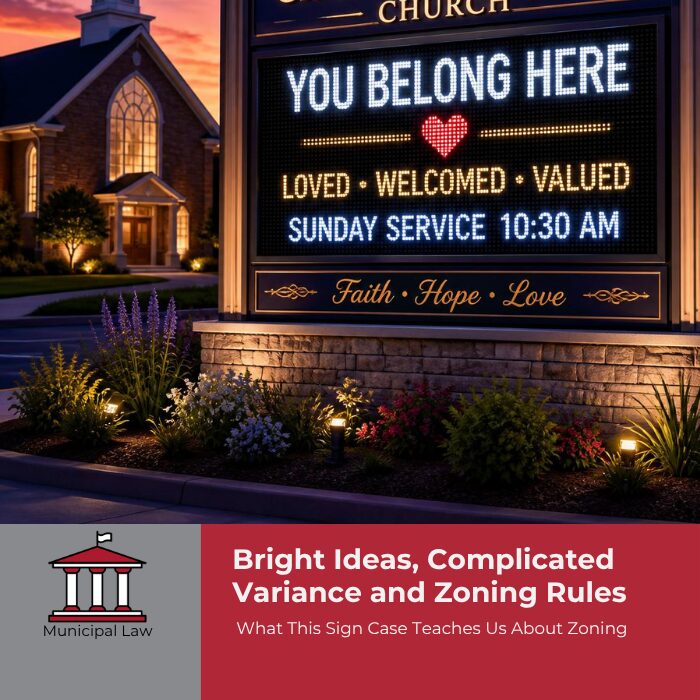
Zoning ordinances help to ensure proper land use for the benefit of the general public. In Kelly v. Haverford Township Zoning Hearing Board, (Commonwealth Court, decided on April 30, 2026), the limits of a zoning ordinance and variances quickly became a contested topic.
United Union Methodist Church (Landowner) is located in Haverford Township, Delaware County. The Church is located in the Township’s INS Zoning District, where signs are permitted. In December of 2019, Landowner applied for a permit to install a LED message board in place of an existing lighted sign.
The Township’s Zoning Officer denied the permit due to the impermissibility of white lights and animated signs under the General Laws of the Township of Haverford. Landowner proposed amber lights for the sign instead of white lights and insisted that the sign would not use graphics that would result in it being animated. A hearing was held on February 20, 2020.
The Zoning Board gave written notice of the hearing on the Landowner’s variance application. Michael Kelly (Objector) resided across the street from the church and opposed the LED message board. Objector testified to the brightness of the preexisting sign, and he expressed that the sign was typically on each day until midnight. Other neighbors expressed concerns about the proposed sign as well, and they believed it would set an unfavorable precedent for in the future.
At a meeting held on March 5, 2020, the Township Zoning Board unanimously approved Landowner’s application, subject to several conditions. Most importantly, the size of the new sign could not exceed the size of the preexisting sign, the sign could not have any advertising, and the sign could not have any animation or graphics.
On April 1, 2020, Objector requested a copy of the order from the Zoning Officer. Additionally, he asked for information about filing an appeal. There were only 30 days to file an appeal, and the Zoning Officer failed to send Objector a copy of the Zoning Board’s order. Objector filed an appeal on June 30, 2020, resulting in the 30 day deadline being missed.
On July 26, 2023, the trial court directed the Zoning Board to “issue and file its Findings of Fact, Decision, and Conclusions of Law.” Subsequently, on October 24, 2023 the Zoning Board issued and filed its written decision. The Landowner was deemed to have sustained its burden, and the variance was granted. More specifically, the Zoning Board noted that the request for relief from the lighting requirement was a request for a dimensional variance, requiring a lower standard of review. Since white LED lighting is unavailable without graphics, Landowner established an unnecessary hardship. Additionally, the Zoning Board believed that the proposed sign would not affect the neighborhood due to the location and dimension of the sign remaining the same, but with reduced brightness and hours of operation.
The trial court denied Objector’s land use appeal due to it being outside of the 30-day window to appeal. The trial court also believed that the Objector was not a party in the matter, and the Objector’s appeal was also denied on its merits.
Additionally, the trial court specifically addressed Objector’s belief that the Landowner did not meet the requirements for a variance. In particular, the Landowner demonstrated unnecessary hardship because the required white lights cannot be obtained. A message board without animation or graphics requires amber or red LED lights. Lastly, the conditions imposed by the Zoning Board addressed all of the concerns Objector previously raised.
On appeal to the Commonwealth Court of Pennsylvania, the Objector presented five arguments, three of which were addressed by the court. On appeal, the Objector argued and the court considered:
- If the trial court erred in holding that his appeal of the Zoning Board’s decision was untimely.
- If the Zoning Board erred in treating Landowner’s application as a request for a dimensional variance.
- If the Landowner failed to prove all the elements for a variance, in particular, unnecessary hardship.
As for the timeliness of Objector’s appeal to the trial court, the Pennsylvania Municipalities Planning Code (MPC) requires land use appeals to be filed 30 days after the Zoning Board’s decision gets entered. Because the Objector was not mailed a copy of the decision, he did not feel that the decision was properly entered. Therefore, he believed that the appeal period had not yet began running. Objector had his name and address filed with the Board, making him entitled to notice of a zoning board decision, which he did not receive. Because the Objector participated in the Zoning Board hearing, he had standing to contest Landowner’s variance appeal. Ultimately, any defect with the filing was cured by the Objector’s timely supplement to his appeal that was filed after the Zoning Board issued its written decision. Therefore, this Court reverses the trial court’s holding that the Objector’s appeal was untimely filed.
In Objector’s next argument, he contended that where a zoning ordinance prohibits a type of sign, a use variance is required. Because Landowner tried to adjust the Zoning Ordinance regulation of the color of the lights for the lighted sign, there was a dimensional variance. This type of variance existed because different colored lights is a quantifiable requirement for use, whereas a use variance permits a use that is entirely outside the zoning regulations. As a result, the Zoning Board correctly viewed the Landowner’s application as a dimensional variance.
Additionally, Objector argued that Landowner did present ample evidence of unnecessary hardship for there to be a variance. The Zoning Board found that it was impossible for Landowner to install a new sign with lettering in white LED lights unless it also has animation, as a non-animated sign must use amber or red lights. Importantly, impossibility of compliance is a key factor when deciding whether there exists an unnecessary hardship for a dimensional variance. As a result, the Landowner did in fact illustrate the impossibility of finding white lights and subsequent unnecessary hardship, resulting in there being a dimensional variance.
Ultimately the Objector’s June 30, 2020 appeal of the Zoning Board’s decision was deemed to be premature, but his timely supplemental appeal cured any jurisdictional defect. Landowner demonstrated that there was a dimensional variance, and he also proved all of the necessary elements for this type of variance. Therefore, the trial court’s order denying the Objector’s land use appeal was affirmed.
A key takeaway from this case is the importance of being aware of the zoning ordinances that exist in one’s area, as well as the required elements for a zoning variance to deviate from an ordinance.